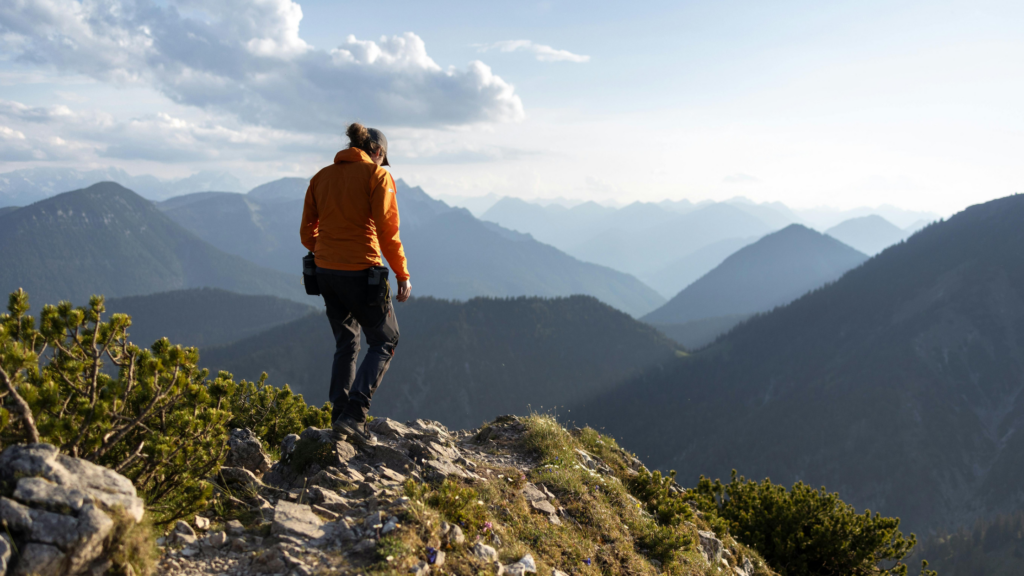
I’ve done a fair bit of exploring this year, both literally and in the more general sense of the word.
First there was the Larapinta Trail, where I spent two weeks walking through some of the most extraordinary country I’ve ever seen — and even longer talking your ear off about it after I returned!
Then I jetted off to Canada, which brought another opportunity to get away from the usual rhythms of work and have the sort of experiences that rarely feature as neatly in the itinerary as they do in your memories afterwards.
Somewhere along the way, I heard a phrase that made me smile:
“I’m not lost, I’m exploring.”
It turns out to be the title of a song by Jana Stanfield, released back in 1993, so I’m a little late to the party. The timing for me, however, felt rather perfect.
Now, anyone who has travelled with me will know that I’m generally the person doing the planning. I’m the one making bookings, looking at maps and working out which places we’d like to visit — I quite enjoy that part of travelling, and I’m certainly not suggesting we abandon the itinerary altogether.
Yet some of the experiences I remember most fondly from Canada involved allowing ourselves to wander a little. Spending time exploring Québec City without a particular destination, coming across places we hadn’t anticipated visiting, and stopping to look at things that caught our attention.
There was also an art installation in Vancouver that prompted the sort of curiosity I particularly enjoy: encountering something unexpected, looking a little closer and finding yourself thinking about something you hadn’t set out to investigate.
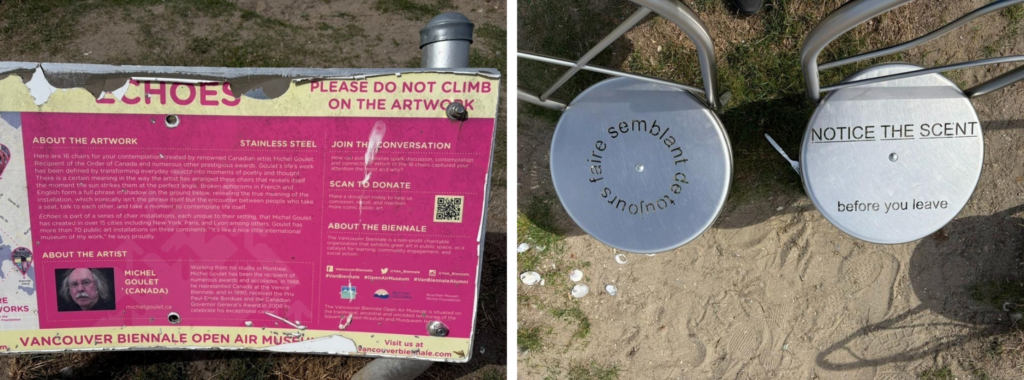
[Images: Vancouver installation]
I find it interesting how comfortable we are with the idea of exploring when we travel. We make plans, book accommodation, work out (roughly) where we’d like to go and then leave room for the unexpected. Perhaps we discover somewhere we’d never heard of, spend considerably longer in one place than anticipated, or decide that the thing everyone told us we absolutely must see isn’t really our cup of tea.
Generally, we consider these experiences a perfectly successful holiday. Yet in our professional lives, we can be far less generous with ourselves when the path isn’t immediately obvious.
As November rolls around, the questions about what’s next always become particularly insistent. What are you planning for 2027? Are you going for that promotion? What’s the next move for your business? Any travel booked in? Where do you see yourself this time next year?
I understand the appeal of having answers — I’m a strategy nerd, after all, and very fond of a good plan. Give me some butcher’s paper, a few pens and a room full of people with ideas, and I’m more than happy!
I also spend a lot of time coaching people who are working out their next professional move, and I see how uncomfortable periods of uncertainty can be, particularly for people who are usually very good at making decisions and getting things done.
Perhaps being competent and capable makes the uncertainty even more uncomfortable. When you’re accustomed to knowing how to approach a problem, having a question you can’t immediately answer can feel quite inconvenient.
This train of thought got me wondering whether some of us might be doing considerably more useful exploring than we give ourselves credit for.
Exploration is different from drifting
I do want to make an important distinction here, because “just explore” could very quickly become the sort of advice that sounds lovely and gives you absolutely nothing to work with.
And you know me well enough by now to know I’m hardly going to suggest abandoning all strategy in favour of wandering around and hoping for the best.
Exploration still requires intention!
When we’re drifting, we’re largely allowing things to happen around us without much consideration of where they might take us. When we’re exploring, we’re actively gathering information, following our curiosity and learning from what we encounter — even if we haven’t quite worked out where we’d like to end up.
I can think of a good example from my own career.
After spending many years working in the union movement, I was ready to stretch myself and explore how I might use my experience in another sector. Sustainability was an area I was increasingly interested in, particularly as the conversations around climate change and our collective responsibility were becoming harder to ignore.
So, I applied for a role at Sustainability Victoria… And I didn’t get it.
As it turned out, that was a very good thing, although I doubt I’d have described it quite that way when the rejection first arrived.
The organisation came back to me with a different possibility, and after a cuppa with the Deputy CEO, I was offered a role as a facilitator. It gave me the opportunity to apply the skills I’d developed through years of working with people, bringing different perspectives together and helping groups work through complex issues — all in a sector I was keen to contribute to.
I hadn’t set out to find that particular position, I didn’t even know it was an option when I first applied.
What I did know was that I wanted to keep learning, that sustainability was something I cared about, and that I had skills I wanted to put to good use.
Being open to a different opportunity allowed me to take those things in a direction I hadn’t originally imagined.
I spent three years at Sustainability Victoria, learned an enormous amount and met some wonderful humans. The experience also led to other opportunities and connections that have continued to influence my work.
It’s a useful reminder that you can have a clear sense of the direction you want to move in without knowing precisely what the destination will look like.
I know that can be particularly confronting. There is often a lot invested in the version of ourselves we imagined becoming, and changing direction can feel like throwing away all the effort it took to get there.
Yet the experience, effort and learning don’t disappear simply because you’ve decided to use them differently.
I see similar things in coaching. When somebody is considering a career change, for example, there’s quite a lot they can learn before deciding to hand in their resignation. They might speak with people working in a different field, take on a new project in their current role or investigate what a particular opportunity would actually involve.
Sometimes exploration also reveals that the original question wasn’t quite the right one.
Each experience gives us something to consider. Did we enjoy it? What surprised us? What assumptions did we bring into the experience, and have any of those changed?
That last part is important. Exploration becomes useful when we make something of what we’re learning, rather than moving from one interesting possibility to another indefinitely.
And sometimes, after exploring quite thoroughly, you discover that you’re perfectly happy where you are. The point is to give yourself enough information to make a more informed choice about what comes next.
Which brings me to something I think is particularly helpful at this time of year, when we have a natural opportunity to reflect on what we’ve experienced and what we might want to explore in the year ahead.
A little values work before the year is out
If you’ve completed Take on Board KickStarter or worked with me in coaching, you’ll know I’m a fan of exploring values.
I use values exercises because they help us get clearer about what is important to us, particularly when there are several possible directions and no obvious right answer.
They can also help us understand why certain experiences feel particularly satisfying, why others leave us frustrated, and why an opportunity that looks excellent from the outside might not feel quite right once we start examining or experiencing it.
Looking back at my own career, I can see how the desire to make a positive difference and keep learning has influenced some significant decisions. Those considerations were certainly part of what drew me towards sustainability, even though the role I eventually took wasn’t the one I initially had in mind.
The true test lies in how those values guide what you pursue, what you embrace, and what you choose to walk away from.
At this time of year, when many of us are reflecting on what we’ve done and beginning to think about what we’d like more, less or perhaps something entirely different from in 2027, I think there’s a good argument for revisiting our values before we start making ambitious new plans.
Here’s a simple values clarification exercise, adapted from the kind of work we do in KickStarter, that you can try over a cuppa or perhaps during a quiet afternoon over the summer break.
Start with ten
Find a list of personal values (I like to reference this one from Brene Brown) and choose ten that feel particularly important to you at the moment.
There are no prizes for choosing the most impressive-sounding words, and I’d encourage you to think about the difference between the values you genuinely hold and those you think you ought to hold.
For example, adventure might sound terribly appealing until you consider how much you also value predictability and a good night’s sleep. Perhaps both are important to you, which is useful information in itself.
Narrow it down to five… then two
This is usually where things become interesting. Most people can identify ten values without too much difficulty, although asking them to narrow that list to five and then just two can prompt some rather spirited internal negotiations.
I sometimes encourage people to identify their two most important values because it requires them to consider what they really want guiding their decisions.
You’re not throwing the others away forever, and having two values to focus on doesn’t mean the remaining eight suddenly stop being important. We’re simply trying to understand which ones might be particularly useful as a reference point for the choices ahead.
If you find yourself torn between two values, it’s worth considering why. That might tell you something about the different things you’re trying to make room for in your life.
Look for where those values showed up this year
With your two values in front of you, think about a time in 2026 when you felt you were really living them.
What were you doing, who were you with, and what made that experience particularly meaningful?
Then consider a time when you felt frustrated, uncomfortable or out of sorts. Was there something happening that didn’t sit comfortably with one of those values?
Perhaps you value independence and have spent much of the year feeling constrained by decisions you have very little say in. Maybe connection is important to you, yet you’ve found yourself working increasingly alone. Or perhaps learning is one of your values and you’ve realised that you’ve spent twelve months doing work you could practically do in your sleep.
Those observations can tell us quite a lot about what we might want to change, continue or explore further.
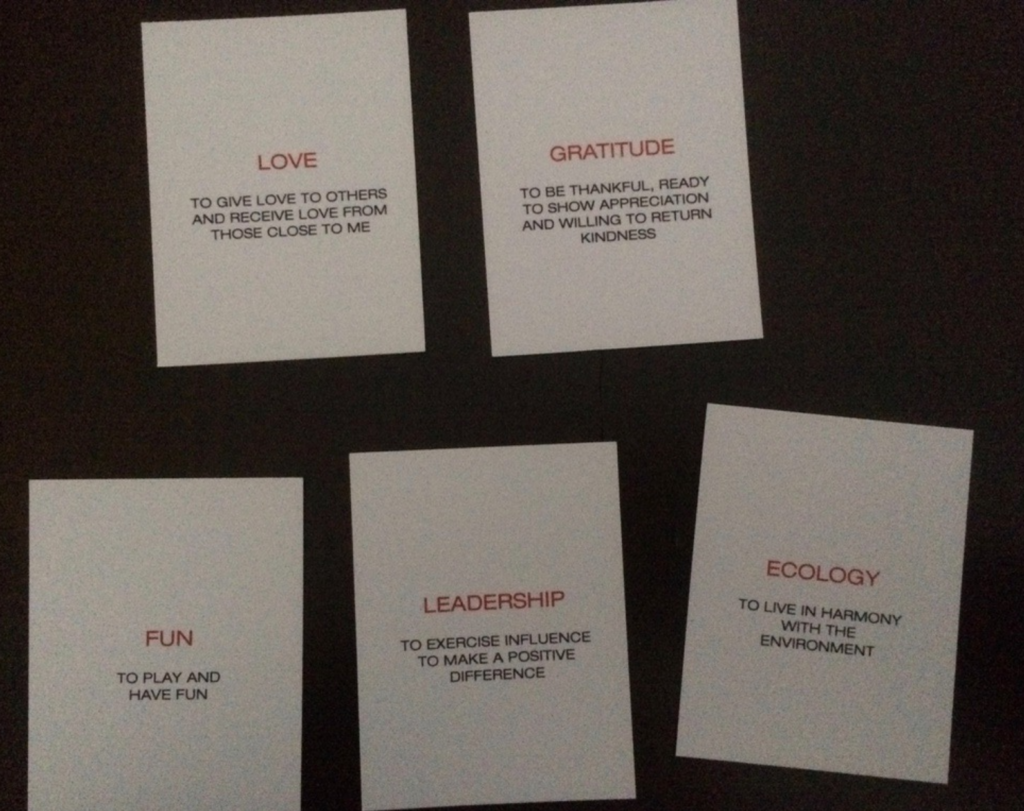
[Images: My top five values: Love, gratitude, fun, leadership, ecology]
What might you give yourself permission to explore next?
You’ve identified your values, considered where they’ve shown up in your life this year and perhaps recognised a few places where things haven’t quite aligned. I think that’s a pretty good way to approach 2027.
You know a little more about what you stand for, what that looks like in practice and what you want to make room for. Now you can start making choices that reflect it, while leaving yourself open to the things you haven’t discovered yet.
This is my last Ideas to Action for 2026, although I can assure you the ideas themselves have never been particularly respectful of an editorial calendar 😉.
Whatever 2027 has in store, I hope you’ll take what you’ve learned this year and use it to build something that feels right for you. There will be decisions to make, opportunities to pursue and, I’m sure, a few unexpected turns along the way.
And if somebody asks what you’re planning for 2027 and you haven’t quite worked out every detail, I rather like the idea of having an answer ready:
I’m not lost, I’m exploring.
Here’s to finding out where that takes us!