The moments that move us forward rarely happen alone
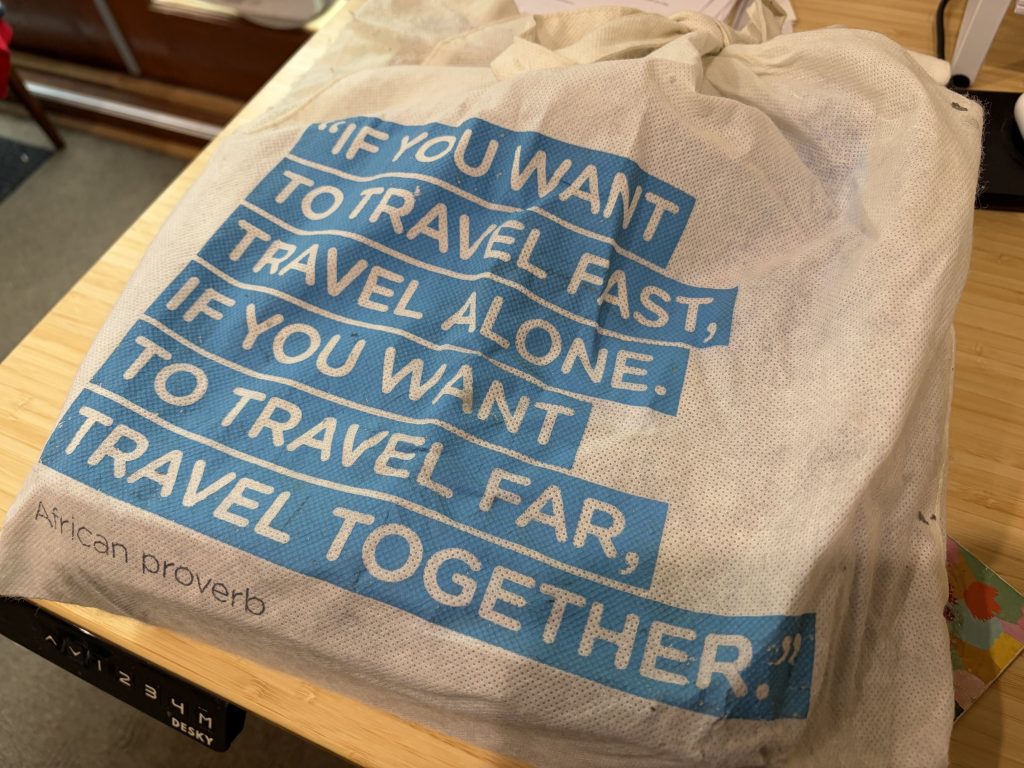
Years ago, I did an adaptive leadership program with the fabulous Diana Renner. We were given one of those tote bags you often get at workshops. This one has “If you want to travel fast, travel alone. If you want to travel far, travel together.” The bag (and Google) tells me that this is an African proverb*. That course was about 10 years ago, and I still have that bag — it comes with me to all my workshops. Travelling far as I guide groups to travel together.
*Although I have also read that’s not an African proverb
One of the lessons of leadership is that thinking alone has limits. You can analyse a situation, weigh the options, rehearse the conversation in your head, and still feel uncertain about the way forward. Having the right people around you can make all the difference. People who steady you, challenge you, help you think clearly, or remind you who you are when things get noisy. People who listen to you.
Those people are key. They’re your support crew.
Over time, you realise just how much having those people around you changes what’s possible. Not because they do the work for you, because they help you go further — and stay well — while you do. They’re the ones who have integrity between what they say and what they do, they care enough to challenge you when you’re off course, and they don’t disappear when things become difficult.
Trust is built in tiny moments
A key part of a strong support crew — whether they are at work, home or play — is trust.
Brené Brown describes trust as a marble jar. Each small act of care, integrity or reliability adds a marble — each breach removes one. I often return to that metaphor because it mirrors what I see in practice. Trust accumulates quietly, through repetition, and it erodes quietly too.
Support crews are built the same way. Not through grand declarations of loyalty or intensity. Through consistent, small behaviours over time.
So, if you’re reflecting on who belongs in your crew, don’t look for the person who once gave you brilliant advice in a crisis. Look for the patterns. Who listens without rushing to fix? Who can challenge you without shaming you? Who tells you the truth kindly, and stays in the conversation?
A practical lens: BRAVING
I love a good framework, and even better, one that helps make invisible dynamics visible. Brené Brown’s BRAVING inventory ticks the box — as Brene often does.
Having said that, a good framework isn’t a ‘tick the box’ checklist — it’s not something I “apply” mechanically nor do I encourage you to do so. As always, the power is in the reflection time and this framework provides powerful prompts for reflecting on trust in action.
Here’s the shorthand:
- Boundaries: Are expectations clear and respected?
- Reliability: Do we do what we say we’ll do?
- Accountability: Do we own our mistakes and repair them?
- Vault: Do we keep confidences?
- Integrity: Do we choose what’s right over what’s easy?
- Non-judgment: Can we ask for help without being shamed?
- Generosity: Do we assume good intent and interpret kindly?
When I facilitate groups like boards, executive teams, or advisory groups, I see how powerful it is when people can name which part of trust feels strong and which feels thin. It moves the conversation from vague generalisation to constructive clarity.
Start with self… and then assess your crew (2-3 people is enough)
When people hear “support crew”, they sometimes imagine they need a dozen people and a group chat. Most of the time, 2-3 people is plenty.
Your crew can be different across contexts: personal, professional, community.
The strength is in trust, not volume.
Choose 2-3 people who help you go further, and then run a gentle BRAVING check.
Firstly — and this is key — start with yourself. Much like giving good feedback, you first need to be able to ask for — and really hear — feedback on you. Having the right support crew relies on you showing up with trust. Use the BRAVING inventory to assess how you are showing up to your support crew.
For yourself, and then each person in your crew, ask:
- Where do I (or they) show up consistently in ways that build trust?
- Where does trust feel thinner — strained, inconsistent, or unspoken?
- What kind of support do I genuinely turn to them for? (and them to me?)
- And what do I offer them in return? (and them to me)
You might notice you’ve been using the right person for the wrong job. Someone can be brilliant for celebration, and not the person to hold your most vulnerable uncertainties. Helping to see which is which can be both clarifying and uplifting — as well as considering who you show up as, with who and when.
Why this matters
Leadership is often a lonely role.
Complex work often has to be carried quietly. You’re balancing confidentiality, competing interests, incomplete information, and real consequences. There isn’t always space in a formal room to test your interpretation, voice uncertainty, or slow your thinking.
That’s where your support crew matters.
Without one, patterns tend to creep in. You default to the safest option, even when it isn’t the wisest. You move too quickly and miss the real issue. You carry too much alone, which narrows creativity and increases reactivity. Or you avoid the hard conversation, and regret it later.
A strong support crew interrupts those patterns and reduces insularity. They help you slow down when you’re rushing. Help you to choose a way forward when you’re stuck. They widen your thinking, helping to get you out of your own head.
Small, practical moves you can take this week
If you want a light, useful place to start:
- Name your 2-3 people.
- Do a BRAVING self-check on how you’re showing up with your crew.
- Do a BRAVING check on each relationship.
- Pick one element you want to strengthen this month (reliability, boundaries, accountability). Take one action.
- Ask for a conversation you’ve been postponing
- Set a boundary kindly and clearly
- Repair something small
- Thank someone for a specific “marble in the jar” moment
- Invite a person into your support crew explicitly
A question to sit with
Where do you need more support this year, and what would it look like to ask for it clearly?
Because going further is rarely about pushing harder, often, it’s about trusting better.
If this has prompted you to reflect on who’s in your support crew — or who might need to be — and you’d value a conversation about it, I’m always happy to explore that with you.