A practical way to pause, unplug and notice what needs your attention before deciding what comes next
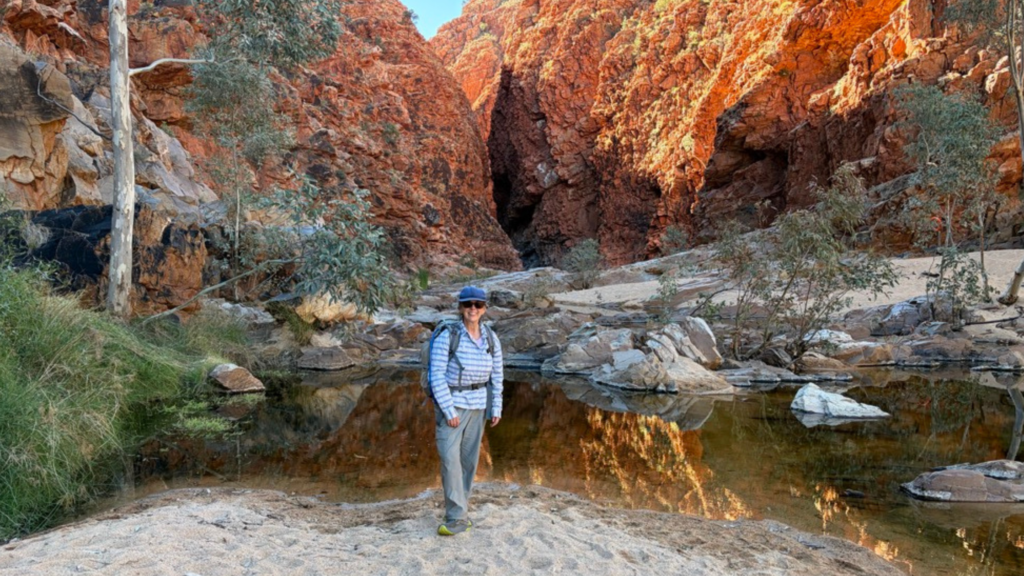
I’ve just come back from two weeks walking the Larapinta Trail, and for most of that time my only real job was to get up and walk.
The guides would tell us over dessert what time breakfast was, whether we needed to be packed before we ate and when we were leaving. The food appeared, the route was set, the next camp was organised, and I didn’t need to decide what to cook, what to read, what to listen to, which meeting to attend, or which small thing required my attention next.
I just had to walk. Which, it turns out, is quite a wonderful brief.
I didn’t read a book, listen to a podcast, or open the news. The few times we had phone reception, I sent my partner a message along the lines of “still alive, here are some photos,” and he replied with a photo of our cat.
Perfect, really 😍
What surprised me was that I didn’t miss the inputs of daily life. I didn’t have to wrestle myself away from my phone, or nobly resist the urge to check social media. I was in such a beautiful place, moving my body every day, sleeping under the stars, looking out at mountain range after mountain range, that the usual noise just fell away.
And when I came back, the question that I kept coming back to was not just, “how do I get more of that?” — although, yes please! It was also “what becomes possible when we give ourselves enough space to notice what is actually going on?”
The flotsam and jetsam test
Before I left, I asked Lisa to keep my inbox empty.
This was because I knew that if I briefly had reception and saw 15 emails waiting for me, my brain would immediately start sorting, responding, remembering and managing. So the incredible Lisa kept things moving and when I got back my inbox was still empty, with a document waiting that showed what had happened while I was away.
What struck me was how little of it actually needed me. Some of it needed a response, and perhaps 10% needed my actual attention.
When you are in the middle of work, everything can feel connected to you. You are in the meetings, seeing the emails, tracking the details, holding the threads, and often telling yourself that it all needs your hand on it in some way. Then you step away properly and realise that many of those threads hold just fine without you tugging on them every day.
That can feel slightly confronting, it can also be quite freeing.
July has its own kind of momentum. New financial year, new plans, new calendars, new priorities, and everyone getting that particular “right, let’s get moving” energy.
I like that energy — I really do — and I also think this is exactly the moment to pause before filling every available space.
A strategic pause is most useful before you think you need one. Not only when everyone is exhausted, not only when the next formal planning day is looming, and not only after the wheels have already started wobbling.
A pause gives you room to notice what is already there.
What has shifted? What feels heavier than it used to? What keeps coming up in conversations? What is quietly working, even if no one has named it yet? What might be flotsam and jetsam?
Sometimes you need a 14-day walk in Central Australia. Sometimes you need 30 seconds before you step into a meeting.
Anything in between counts too.
Reading more than the map
On the trail, we knew where we were walking, roughly how far we were going, where we would sleep, and what needed to happen next. The guides were excellent at metering out information as we needed it, rather than giving us everything all at once and expecting us to hold it.
And even with a good plan, the work was not just following the map. It was reading the terrain.
The weather, pace and heat. The energy of the group — the person who was quieter than usual, the person who might need a little more information, the person who might need less.
At one point, one of the guides noticed that someone was experiencing heat stress before she had fully recognised it herself. He saw the signs and put a plan in place before it became something much more serious.
It is practical and emotional. It comes from being present enough to notice the small signals before they become big ones. That feels very familiar to me in workshop rooms.
As a facilitator, my job is not only to follow the agenda. It is to notice what is happening in the room. Who has gone quiet? Who is carrying the conversation? What is being raised as a “small thing” that may not be small at all. What needs to be slowed down before the group moves on.
From helicopter view to universe view
In board and strategy work, people often talk about needing a helicopter view.
After sleeping under the stars in a swag for the first time, I did find myself wondering whether we sometimes need to zoom out a little more than a helicopter can.
A star view, perhaps… or a universe view.
Because when you open your eyes in the middle of the night and see that sky full of stars above you, there is a very quick remembering that we are tiny beings on a very large earth, in an incomprehensibly large universe.
A useful thing to remember occasionally, especially when the inbox, the meeting, the report or the latest “urgent” thing has started to feel like the whole world.
How I build pauses into workshops
This is one of the reasons I deliberately build pauses into workshops.
Where possible, I like to run sessions in places where people can get outside. Pair up or take a moment to think on your own, maybe go for a walk for 10 minutes, then come back into the room.
This gives people time to form their own thoughts before they are influenced by the first person to speak. It supports different thinking styles, and it means those who are less likely to jump in still have a way into the conversation.
And yes, there is always someone who wants to start talking during the silent reflection time. I have enormous affection for those people, partly because I can be one of them!
I sometimes see people trying to shorten breaks to squeeze in more content. Please don’t. Breaks are part of the work. They are often where people connect ideas, build trust, check something quietly, or come back and say, “I’ve been thinking…”
A small sensing check
If you want a practical place to start, start small.
Before your next meeting, decision, workshop or planning conversation, take 30 seconds and breathe.
Breathe in for four, breathe out for six — and repeat a few times.
If you have a little more time, try naming:
- 3 things you can see,
- 3 things you can hear,
- 3 things you can feel,
- 3 things you can smell — if smell is available (and not too strange in your context… i.e. maybe not in the office bathroom).
On the trail, this might have been the crunch of my feet on the ground, birds, air on my hands, the sun on my back. In an office, it might be the hum of the heater, someone’s cup of tea, the light through the window, your feet on the floor.
It sounds simple because it is — that’s the point.
You are bringing yourself back into the moment so you can notice what is actually happening, rather than reacting to the noise around it.
Then, if you have even more time, you can ask yourself:
- What am I noticing?
- What needs more attention before we move on?
- What might we be missing, if anything?
Hot tip: that “if anything” matters just as much.
Sometimes nothing is being missed. A pause is not about slowing everything down for the sake of it, it is about making a better choice about what comes next.
The gift of stepping away
The other thing I have been thinking about since coming back is that stepping away is not only good for the person who steps away — it can be good for everyone else too.
When you are not there, other people have to step in, make decisions, hold the threads and trust themselves a little more.
I am a small business, so perhaps this is less dramatic than it might be in a larger organisation. Still, the principle holds.
While I was away, Lisa kept things moving and the board I am on had an acting chair in place.
It turns out the world continues. Who knew?
For people in leadership roles, formal or informal, this can be a useful reminder. You do not have to be in everything for everything to work. In fact, sometimes your absence creates the space for others to lean in.
That only happens, of course, if you actually step away.
A question (or invitation) to sit with (or pause on)
So perhaps instead of leaving you with a question this month, I leave you with this invitation:
Unplug!
For 30 seconds, for an afternoon, for a workshop, or for two weeks if you can.